


The Stormbird's Return
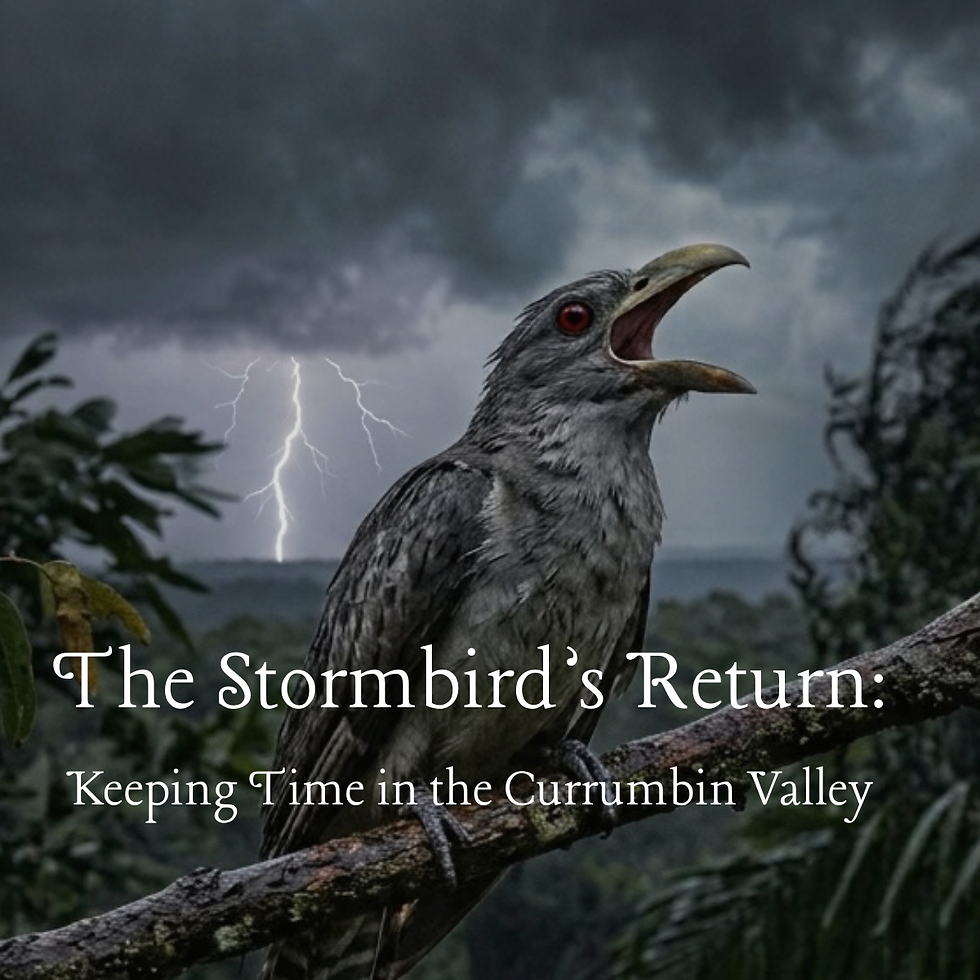
I remember one Spring evening, many years ago, as I lay in bed asleep in our Currumbin Valley home. I was rudely awakened by a loud, raucous sound, cutting through the gentle silence that had enveloped the valley.
The sound had an urgent, heavy, and ancient ring to it. A sound that vibrated in the chest cavity and made the hair on my arms stand up even before my eyes snapped open. I bolted upright in bed, heart hammering against my ribs, and threw off my blanket to investigate.
Outside our home, the forest canopy seemed to shudder under an oppressive, bruised-purple sky. The air was thick, heavy with the scent of dry earth and impending rain.
And there they were, half a dozen dark silhouettes flying around in the night sky.
It was my first full year living here on Kombumerri Country, our little cottage perched on a hill beside a natural waterway & billabong. And apparently the Channel-billed Cuckoos had just arrived from the tropical north. Calling out, reconnecting with country, claiming territory, calling for mates. Interestingly, their arrival seemed to coincide with the advent of the first rains and storms of the season.
Known widely across sub-tropical Australia as the "Stormbird," the Channel-billed Cuckoo is impossible to ignore. They are the world’s largest cuckoos, striking and prehistoric-looking, with massive, pale, downcurved bills, grey plumage, and long, barred tails. When they arrive in the valleys of the Gold Coast hinterland, they bring a distinct presence.
They arrive in spring from Indonesia and New Guinea—riding the monsoon currents down the coast to the eastern seaboard just as the season's first rains start.
They do not come quietly. Their call is a loud, echoing, almost mechanical shriek that cuts straight through the dense humidity, calling across the gullies and ridges. It is a sound that demands attention, echoing off the green walls of the valley like a warning bell.
Rain Keepers and Season Changers
Over the years, I've come to appreciate the seasonal presence of the Channel-billed Cuckoo. They have become like a living barometer to me, and their loud calls provide a reassuring sense that rain is on its way.
Long before BOM radar screens and weather apps, apparently the local indigenous people looked to the arrival of the Stormbird as seasonal harbingers. True to their nick-name, within hours of their resonant chorus filling the Currumbin canopy, the sky typically fractures. Lightning splits the ridge, thunder rolls down the creek lines, and the first fierce, cleansing downpours of the season soak the parched soil, waking up the dry forest floor. They are timekeepers of moisture, marking the volatile, beautiful transition from the dry months into the sub-tropical wet.
There is a fascinating, complex ecology to their arrival, too. As brood parasites, they slip their large eggs into the nests of unsuspecting local hosts—mostly Pied Currawongs, Australian Magpies, or large corvids—entrusting the raising of their demanding, oversized chicks to local adoptive parents. It is a dramatic, high-stakes game played out in the leafy high-rises of our valley every single year.
Keeping Time and Place
The seasonal calendars observed within the ecosystem of Kombumerri country recognise far more seasons than the imported four-season European model. Here in Southeast Queensland, our year is governed by heat; wet; cool; dry; storms; flowering & fruiting of different plants and the arrival and departure of migratory wings.
While the sun and moon provide a reliable measure of the cycle of time, they miss the particular seasonal nuances for those living deeply in place. It is when the wattles flower, when the cicadas erupt into a deafening wall of sound, and when the Stormbirds arrive to herald the first electrical storms—these are the sacred, central timekeepers. They tell us precisely where we are in the turning of the world.
And yet, like all ecological monitoring in these shifting times, listening to the valley also means bearing witness. Climate disruptions change arrival windows, intensity patterns, and the rhythm of the canopy. To live in place now is to notice when the calls come earlier, when the storms hit harder, and to stay with the challenges of a changing environment.
Listening to the Valley
Despite the concern that can come with watching our seasonal rhythms skew, there is deep solace in the practice of simply paying attention. When you name the turnings of your year after what happens in your ecosystem, your life begins to speak the local language of the land.
Now, whenever that first powerful caw-chow rings out across the green folds of Currumbin Valley, I don't just pull on my wet-weather gear and secure the windows. I pause, take a breath, and feel a surge of grounded belonging. The Stormbirds are back. The rain is coming. The seasonal wheel has turned once more.


Comments